A luxury camp in the Sahara, a bedroom under the Indian Ocean, a mirrored box in a Lapland pine forest, and a heated suite in Antarctica. Twelve of the most unique places to stay on earth, with approximate rates, the best season, and how you actually get there.
The most unique hotels in the world are rarely the ones with the biggest marble lobbies. They are the ones you have to work to reach: a luxury hotel in the Sahara desert that only exists because somebody hauled rugs and copper lanterns across 60 kilometres of sand, an undersea bedroom bolted to a Maldivian reef, a hotel rebuilt from river ice every single winter. These are bucket list hotels in the truest sense, unique places to stay that stay with you long after the trip is paid off.
This guide covers twelve of them. Several do not publish rates at all, and those that do move them constantly, so treat every figure here as approximate and confirm before you book. Some are seasonal, and one (The Muraka) has been closed for refurbishment into October 2026, so always check the property is open for your dates.
Several unrelated businesses market an “Erg Chigaga luxury camp”, so the operator matters here. This is Nick and Bobo’s camp, pitched in Morocco’s wildest dune field about 60 kilometres beyond the last town, M’Hamid, with the final 1.5 hours over terrain rough enough that a 4WD is essential.
The main camp has 13 en-suite tents, each over 25 square metres, with handmade Moroccan furniture, thick rugs, solar lighting and a king bed, and a smaller private camp sits further out. Dinner is served under the open sky, and once the lanterns go down the silence is total enough that you notice your own pulse.
Approximate rate: the camp publishes 265 euros per person per night for the Main Camp, and 265 to 340 euros for the Private Camp depending on group size, inclusive of meals, drinks and activities (quad biking costs extra).
Best season: the camp runs 1 September to 3 June and closes in high summer, when temperatures top 50C. (Not all Moroccan desert camps do this: some near Merzouga, with air-conditioned tents, operate year round.)
Getting there: fly to Marrakech, then about ten hours by 4WD via the Draa Valley. Most people break the journey rather than doing it in one day.
Qasr Al Sarab is the fantasy made literal: a sand-coloured fortress with courtyards, arches and date palms, dropped into the Liwa dunes on the edge of the Rub’ al Khali, the largest continuous sand desert in the world. The name means “palace of the mirage”, and from a distance that is exactly how it reads.
With 140 rooms, 14 suites and 53 pool villas, plus Royal Pavilion villas half a kilometre out, it feels like a resort rather than a camp. That is the trade. What you get in exchange is the Empty Quarter itself: dunes running unbroken for hundreds of kilometres, camel treks straight from the property, and a sky with almost no light pollution in it.
Approximate rate: Anantara does not publish rates openly. Booking sites suggest roughly $300 to $400 a night in low season, rising in winter and for pool villas. Approximate.
Best season: October to April. Summer daytime temperatures in Liwa are brutal.
Getting there: about 2.5 hours by road south from Abu Dhabi, or a 50-minute helicopter transfer, which makes this the easiest bucket list desert stay to add to an existing trip.
Amangiri occupies over 900 acres of the Colorado Plateau near Canyon Point, southern Utah, and its most photographed feature is a pool that curves around an Entrada sandstone escarpment roughly 165 million years old. The 34 suites are concrete, glass and stone, deliberately austere, so the desert does all the decorating.
Camp Sarika, the satellite camp, adds ten tented pavilions with private plunge pools further out in the canyon country. Days go to via ferrata routes bolted into the rock, slot canyons, horseback rides, or a helicopter over Lake Powell.
Approximate rate: Aman publishes no rates. Independent 2026 reporting puts entry suites in the region of $3,700 to $4,600 a night. Approximate, and strongly seasonal.
Best season: spring and autumn. Summer is very hot, winter is cold and clear.
Getting there: Page Municipal Airport is about 25 minutes away. Las Vegas and Phoenix are each around four and a half hours by road.
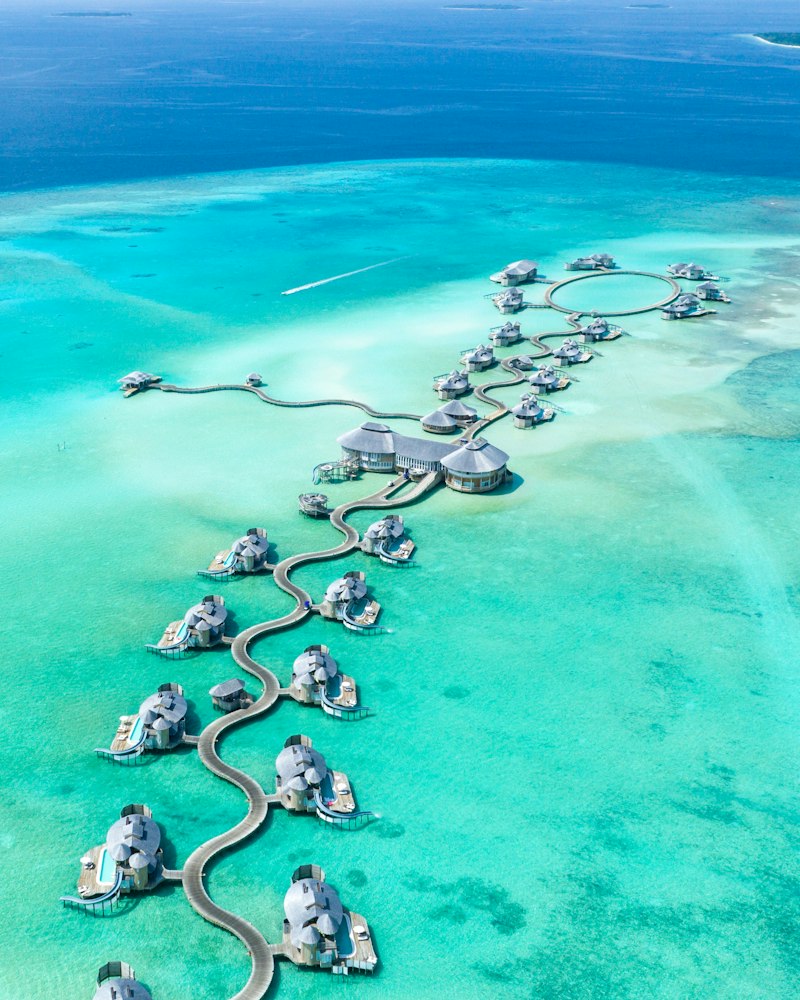
Plenty of Maldivian resorts put you above the water. The Muraka puts you under it. The master bedroom of this two-level, three-bedroom residence sits about five metres (16 feet) beneath the Indian Ocean under a curved acrylic dome, with an undersea bathroom alongside it. You fall asleep watching reef fish drift over the glass.
The upper deck is conventional overwater luxury with an infinity pool. Downstairs is the point. The same resort runs Ithaa, an undersea restaurant five metres down seating 14 guests, open to non-residents too.
Approximate rate: none is published. The resort takes bookings through its own site, by phone or by email, and quotes on request. Press figures have ranged from roughly $15,000 to $25,000 a night, higher at festive peak, so treat any number as an estimate. Note that the resort listed The Muraka, the Spa Retreat, Mandhoo and the Grand Water Villas as closed for enhancements from 1 July to 11 October 2026, so confirm it is open for your dates.
Best season: November to April is the dry season. May to October brings more rain and better diving prices.
Getting there: fly to Malé, then a seaplane transfer of around 30 minutes to Rangali Island.
Nihi sits on the wild southwest coast of Sumba, an island east of Bali that most travellers have never heard of, and that is the entire appeal. There are 31 villas built from local timber and thatch, most with private pools, scattered along a beach that feels like a film set.
Guests have access to Occy’s Left, a private left-hand break limited to 15 registered surfers a day. Horses are swum in the ocean. The signature Nihioka Spa Safari is a full day: a walk through countryside and a traditional Sumbanese village, a swim, then treatments in open pavilions above the sea. Rates include three meals a day, non-alcoholic drinks, yoga, paddleboarding, snorkelling and tours of the Sumba Foundation’s projects. Travel + Leisure readers voted it the world’s number one hotel in both 2016 and 2017, and it placed 35th in the World’s 50 Best Hotels 2026.
Approximate rate: not published by the resort. Third-party listings start around $1,400 to $1,500 a night, which should be read as an estimate.
Best season: surf is best from May to September.
Getting there: fly Bali (Denpasar) to Tambolaka, about a 1 to 1.5 hour flight, then roughly 1.5 to 2 hours by road in an open-sided safari jeep.
There is nothing else like breakfast at Giraffe Manor. This 1930s ivy-covered manor house in a leafy Nairobi suburb has twelve rooms and a resident herd of Nubian giraffe (a population formerly classified as Rothschild’s, and listed by the IUCN as critically endangered) who walk up to the first-floor windows at breakfast and dip their heads in for a treat.
It sounds like a gimmick and is not: the herd is associated with the giraffe sanctuary next door, and the whole operation sits alongside conservation and education work. Stays are fully inclusive of meals, most drinks, laundry, Wi-Fi and entry to that giraffe centre.
Approximate rate: the property does not publish rates and works by enquiry. Press figures around $1,400 per person sharing have circulated, which should be read as an estimate, not a quote.
Best season: June to October for Kenya’s dry season, which pairs naturally with a Masai Mara safari. Rooms book out many months ahead regardless.
Getting there: about 27 kilometres and 40 minutes from Jomo Kenyatta International Airport, or roughly 25 minutes from Wilson Airport if you are flying in from the bush.
Treehotel is nine rooms suspended in a pine forest in Swedish Lapland, each one commissioned from a different architect. The Mirrorcube is a four-metre aluminium cube clad in mirrored glass that reflects the forest until it nearly vanishes. The 7th Room, by Snøhetta, is a black cabin on stilts with a net strung beneath it so you can lie out over the treetops. The Biosphere is wrapped in hundreds of bird houses. There is also a UFO, a bird’s nest, a dragonfly and a blue cone.
Rooms are small, warm and beautifully built, and in some cases the shower is in a nearby building, which is part of the deal. In winter the aurora moves over the trees above you.
Approximate rate: the Mirrorcube starts from around 6,900 SEK per night for two including breakfast and VAT, and the Biosphere from around 14,800 SEK. Prices vary by room and season.
Best season: late September to early March for northern lights. Summer brings the midnight sun and no darkness at all.
Getting there: Luleå Airport is around 70 minutes by car, or take the train to Boden and drive about 35 minutes.
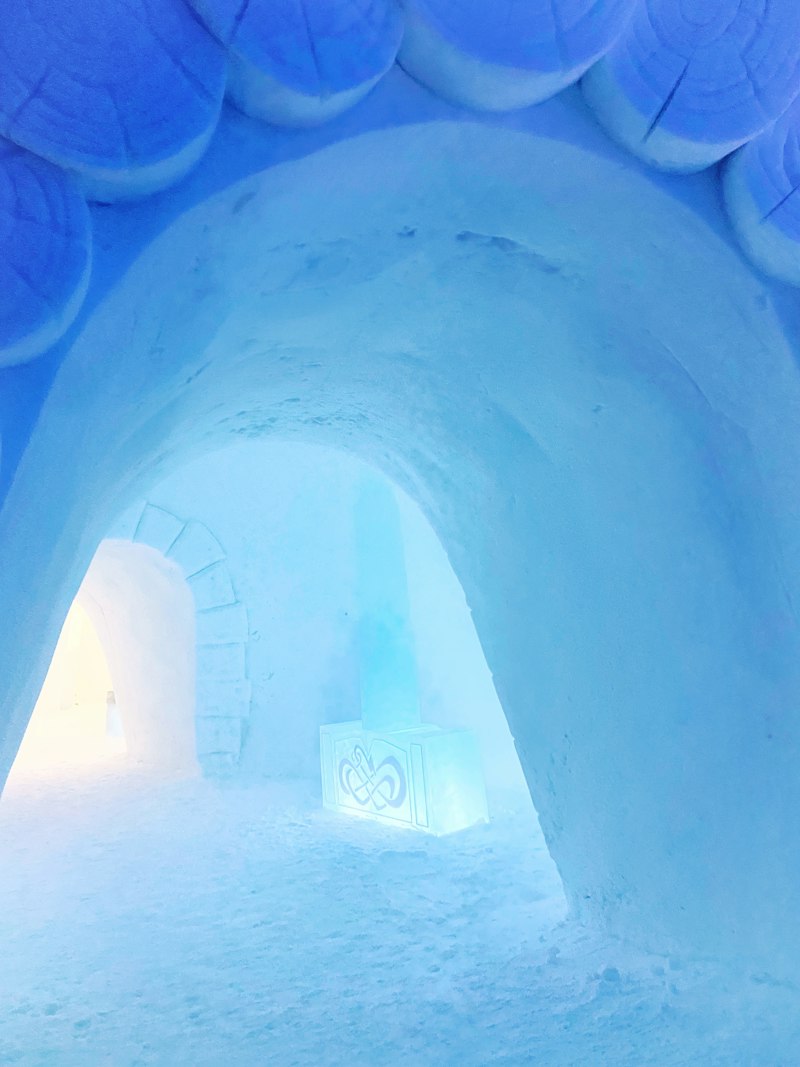
Every winter, artists from around the world arrive in Jukkasjärvi to carve a hotel out of ice harvested from the frozen Torne River. Every spring it melts back into that river, and the next winter a completely different hotel goes up. No two years are the same, so the hotel you sleep in cannot be revisited. (Quebec’s Hôtel de Glace and Norway’s Sorrisniva work the same way, but ICEHOTEL is the original and the largest.)
The seasonal ice hotel runs roughly December to April. ICEHOTEL 365, opened in 2016, is the permanent year-round section: 18 art and deluxe suites held at about minus 5 degrees Celsius and cooled through the summer by 875 square metres of solar panels, which is a wonderfully Arctic paradox. In the cold rooms you sleep in a thermal bag on reindeer hides, with heated facilities, lockers and a sauna in a warm building nearby. Most guests book one cold night and one warm one.
Approximate rate: room rates are not published and vary widely by suite and season, so request a quote. Day visits to tour the ice art are 325 SEK for adults.
Best season: December to April for the full ice hotel and the aurora. ICEHOTEL 365 is open all year.
Getting there: fly to Kiruna, then around 17 kilometres to Jukkasjärvi, roughly 200 kilometres north of the Arctic Circle.
This is the far end of the list. White Desert flies guests from Cape Town to a blue-ice runway in Antarctica, a flight of about five and a half hours, currently operated as an all business class Airbus service (smaller private jets have been used on some flights), and houses them in heated pods at camps taking a dozen people at a time. Echo Camp, opened in November 2022, is six heated fibreglass sky pods with interiors that look like a lunar base. Whichaway Oasis sits beside freshwater lakes.
Days are spent in ice tunnels, among emperor penguin colonies, or flying to the Geographic South Pole. Nothing about it is normal travel.
Approximate rate: White Desert publishes 2026/27 per person prices for shared accommodation, and the camp you choose changes the number a lot. Antarctica in a Day costs $16,500. At the simpler Explorer Camp, Discovery Week is $45,000, Baby Penguins and Blue Tunnels $65,000, and South Pole and Penguins $95,000. The same two itineraries at the sky pods of Echo or at Whichaway Oasis cost $75,250 and $115,500.
Best season: November to February, the Antarctic summer, which is the only window flights operate.
Getting there: Cape Town, then the ice. Book many months out.
Patagonia’s weather does the work here. Explora Torres del Paine sits inside Torres del Paine National Park with around 50 rooms facing the Paine massif, and the building is designed so the view reaches you from the bath, the bed and the pool.
It is genuinely all-inclusive: more than 40 guided explorations on foot and horseback, all meals and drinks, the spa, park entrance fees, and transfers from Puerto Natales. You come down to breakfast, look at the sky, and pick that day’s hike with a guide. Note that Explora runs a second, separate Torres del Paine property as well as lodges elsewhere in Patagonia, so check which one you are booking.
Approximate rate: all-inclusive multi-night packages run from roughly $3,500 per person, varying considerably by season, package length and room. Clearly approximate, and quoted on request.
Best season: October to April, the southern spring through autumn. December to February is warmest and busiest. Wind is a constant.
Getting there: fly to Punta Arenas, then on to Puerto Natales. The lodge is about 112 kilometres north of Puerto Natales, around 1.5 to 2 hours by road, and transfers are included.
Matera’s Sassi are cave dwellings carved into a limestone ravine and lived in for thousands of years. Italy evacuated them in the 1950s as a national embarrassment; UNESCO listed them in 1993. Sextantio took a cluster of the abandoned caves in the Civita, the oldest part of the Sassi, and restored them without papering over the past: raw stone walls, antique linen, and modern comforts such as underfloor heating and concealed lighting kept out of sight.
The rooms look over the Gravina ravine, and by most accounts the evenings are lit largely by candle. Lying in a cave bed, listening to water somewhere in the stone, is about as close to time travel as hospitality gets.
Approximate rate: not published. Third-party listings vary widely, from a few hundred dollars for a cave room to around a thousand and up for a suite. A loose estimate only.
Best season: not stated by the hotel. July and August in Basilicata are hot, so shoulder months are the usual choice.
Getting there: Bari is the nearest major airport, with road and rail connections on to Matera.
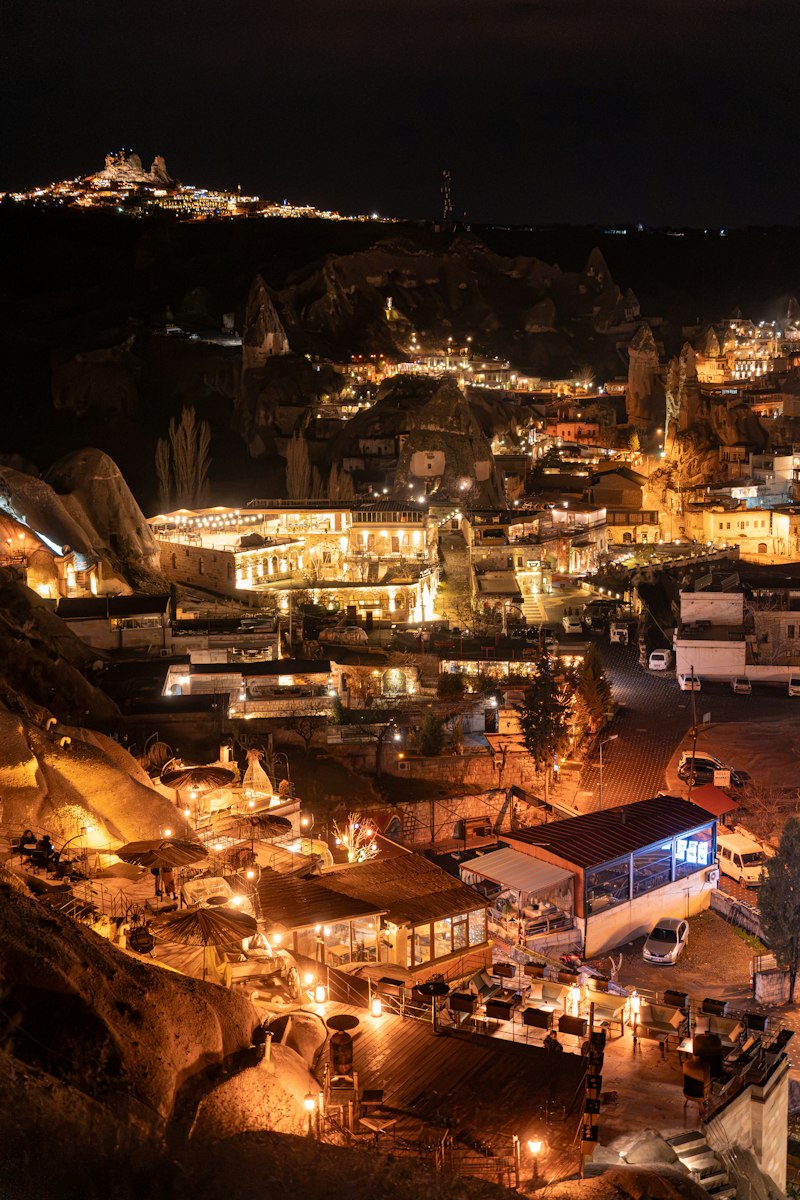
Cappadocia is full of cave hotels. Argos, in the hilltop village of Uçhisar, is the one built out of a restored monastic settlement, with rooms spread through reclaimed cave dwellings and a network of ancient tunnels running underneath, including an underground space now used as a wine cellar.
Rooms look across Pigeon Valley to Mount Erciyes beyond, there is a heated outdoor pool, and the top suite has its own pool inside the cave. The Seki restaurant faces the same view, sourcing ingredients from within about 60 kilometres and herbs from the hotel garden. At dawn, hot air balloons rise out of the valleys below you. The nearby Museum Hotel, a Relais et Châteaux member in the same village, is the other strong option if Argos is full.
Approximate rate: neither hotel publishes rates. Request a quote.
Getting there: Nevşehir airport is about 30 kilometres from Uçhisar, roughly 30 minutes. Kayseri has more flights but is farther, about 70 kilometres and a little over an hour by road.
Book absurdly early. Giraffe Manor, the Treehotel’s aurora dates and Antarctica flights sell out six to twelve months ahead.
Ask what is included. A $3,500 all-inclusive night is not the same animal as a $3,500 room-only night.
Build in buffer days. When arrival involves a seaplane, a blue-ice runway or 60 kilometres of open sand, weather delays are part of the product. Never book a tight connection on the way out.
Insure the trip, not just yourself. When one night costs more than the flights, cancellation and delay cover matters more than usual.
🎒 Pack for remote luxury stays: Merino Base Layer Set · Insulated Down Jacket Packable · Desert Sun Hat UPF · Travel Binoculars Compact · Portable Power Bank · Hard Shell Camera Case
🗺️ Book desert and wilderness experiences: Sahara desert tours on GetYourGuide → · Cappadocia balloon rides and tours on Viator →
🛡️ Travel insurance for remote trips: Get covered with SafetyWing → 🔒 Stay secure on hotel and airport Wi-Fi: Get NordVPN →
The common thread here is not money. It is that somebody looked at a place nobody should be able to sleep in, a dune field, a reef, a frozen river, a cave, a continent with no hotels, and built a bed there anyway. Pick one. Put a date on it.